

Ford Runs 3D Printers Autonomously with Robots
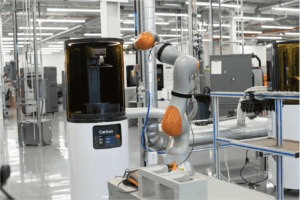
The automation of the future is happening today at Ford’s Advanced Manufacturing Center with a robot on wheels named Javier. He was supplied by German automation company KUKA and has become integral to the development of a process to operate 3D Carbon printers with a mobile robot rather than a fixed, stationary one, the first of its kind in the industry.
The Javier robot has become a very remarkable part of the facility. While he can’t work continuously (since he’s mobile and isn’t plugged into anything, he has to take short breaks to charge) he’s able to run through most of the day and runs the 3D printers without any assistance and without using a camera system to “see”. He also has great accuracy and precision, and that’s only been improving since he was put into use. Ford is able to use feedback from the robot to reduce margins of error. The same method can be applied to other robots already at work to increase their efficiency and reduce costs. Ford has already filed several patents related to the process.
The reason that these pieces of equipment from different suppliers are able to interact at all is because despite the fact that they don’t run the same communication interface, Ford has created an application interface program that helps different pieces of equipment “speak the same language,” and interpret each other’s feedback. For instance, the 3D printer tells Javier when the printing will be finished, then Javier lets the printer know that he has arrived and is ready to pick up the finished product. Without this innovative communication, the process wouldn’t work.
“This new process has the ability to change the way we use robotics in our manufacturing facilities,” said Jason Ryska, director, global manufacturing technology development. “Not only does it enable Ford to scale its 3D printer operations, it extends into other aspects of our manufacturing processes – this technology will allow us to simplify equipment and be even more flexible on the assembly line.”
One of the additional upsides of using Javier to run the 3D printers is that since he can run throughout the night after other employees have left, he increases throughput and is able to lower the cost of custom-printed products, like the brake line bracket for the Performance Package-equipped Mustang Shelby GT500 that Ford has been making with this technology.
While Javier is able to run the main process alone, the 3D designs still need to be uploaded to the printer and the machinery needs to be maintained by human operators at Ford, who are also responsible for engineering new ways to utilize the technology, so this autonomous mobile robot won’t be putting the entire facility out of their jobs anytime soon. He’s simply helping to make the process much more efficient, and hopefully leading to greater innovations in the future!
0 comment(s) so far on Ford Runs 3D Printers Autonomously with Robots